

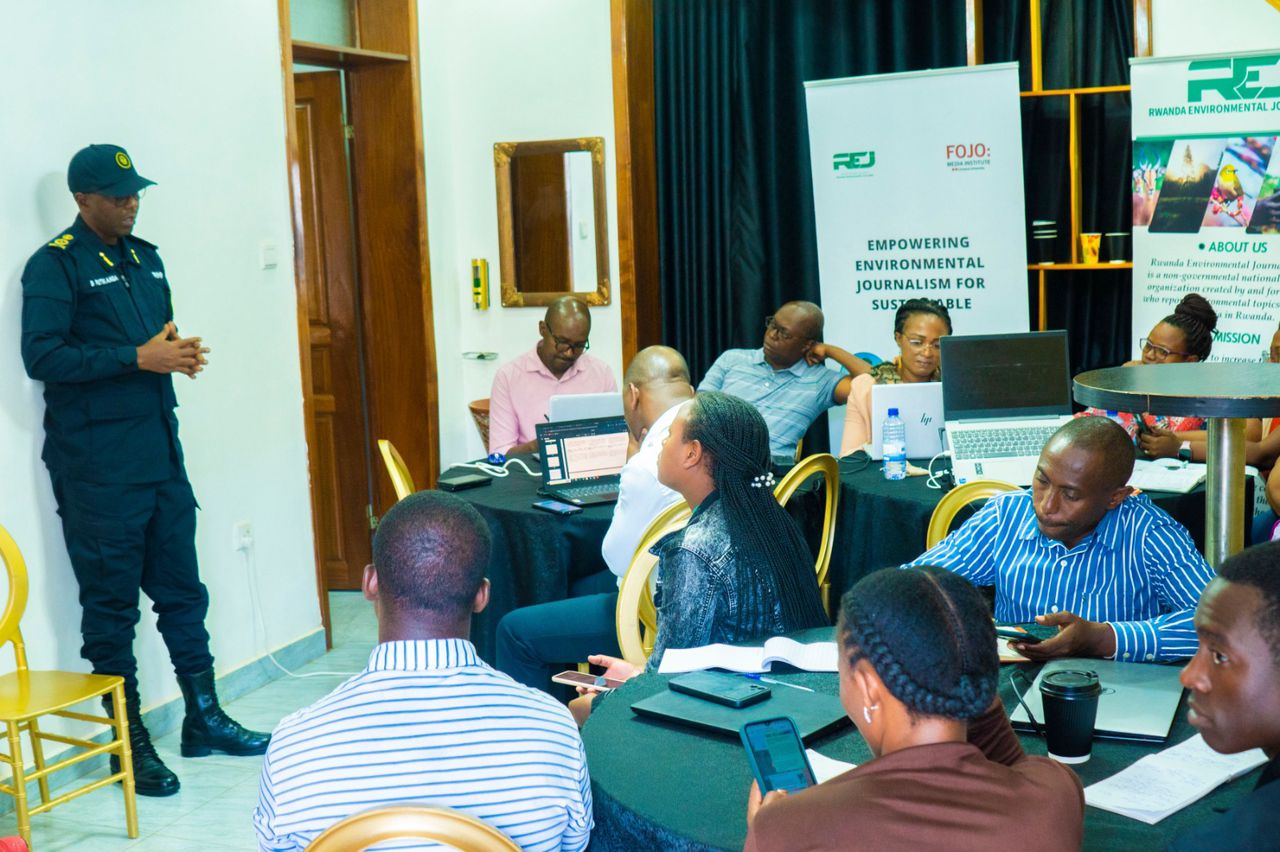
The Rwanda National Police (RNP) has called on journalists to prioritize accuracy and fact verification before publishing news stories, emphasizing that misinformation undermines public trust and accountability.
The call was made by RNP spokesperson ACP Boniface Rutikanga on Wednesday during the closing of a three-day training on fact-checking and verification in environmental reporting. The workshop was organized in Kigali by the Sweden-based Fojo Media Institute through the Rwanda Media Programme, in collaboration with the Rwanda Environmental Journalists Association (REJ).
In his address, ACP Rutikanga urged journalists to be courageous and thorough in their investigations, warning against the dangers of publishing unchecked information or relying on rumors.
“As a journalist, you should not rely on a single source of information,” he said. “You need to consult various sources, compare their accounts, and then make your conclusions.”
He added that finding the truth requires time, critical thinking, and emotional detachment.
“All this demands hard work and commitment,” he said.
ACP Rutikanga further encouraged journalists to take an active role in educating the public about environmental protection, noting that the media has the power to influence attitudes and actions toward conservation.
He reaffirmed the continued cooperation between the Police and the media, saying both institutions share a responsibility to ensure that citizens have access to accurate and trustworthy information.

ACP Boniface Rutikanga, RNP spokesperson
“The Rwanda National Police will continue to closely collaborate with environmental journalists to ensure that Rwandans have access to verified and reliable information,” he said.
According to him, the media plays a vital role in raising awareness about environmental issues and the consequences of neglecting them.
ACP Rutikanga also revealed that the Police increasingly rely on technology to verify information, citing the use of drones, CCTV cameras, and helicopters for surveillance and environmental monitoring.
“However,” he noted, “we often monitor many environmental issues after they are first reported by the media.”
The three-day workshop, which ran from Monday to Wednesday, brought together journalists covering environmental stories and journalism students from various universities.


