

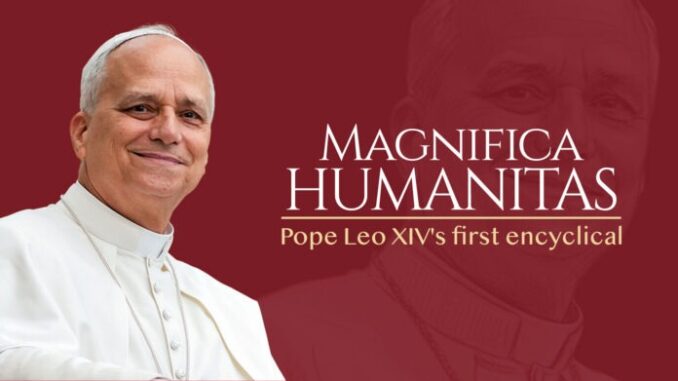
One hundred and thirty-five years after the publication of ‘Rerum Novarum’, the landmark social encyclical issued in 1891 by Pope Leo XIII, the Catholic Church has once again turned to a defining challenge of human civilization. In his first encyclical, ‘Magnifica Humanitas’ (The Magnificent Humanity), Pope Leo XIV revisits the Church’s social teaching in an era shaped by algorithms, artificial intelligence and digital power.
Just as Rerum ‘Novarum’ addressed the consequences of the Industrial Revolution workers’ rights, capital, labor exploitation and social justice, ‘Magnifica Humanitas’ confronts what many describe as the Fourth Industrial Revolution. The new question is no longer only how humans work, but whether technology itself will reshape the meaning of humanity.
Published on 25 May 2026 and signed on 15 May to commemorate the anniversary of ‘Rerum Novarum’, Leo XIV’s first major doctrinal document places human dignity at the center of debates surrounding artificial intelligence, technological monopolies, war, labor, migration and global inequality. The message running throughout the encyclical is clear: technological progress must remain at the service of humanity rather than humanity becoming subordinate to technology.
AI must serve the human person, not dominate it
At the heart of ‘Magnifica Humanitas’ lies a warning: technology is neither inherently evil nor neutral. It reflects the intentions and values of those who create, finance and regulate it. The Pope argues that artificial intelligence risks becoming an instrument of domination when guided exclusively by efficiency, profit or geopolitical competition.“A more moral AI is useless if that morality is decided by only a handful of people,” the encyclical states.
For Leo XIV, the essential issue is not whether AI develops further, but who controls it and for what purpose. He warns against technological concentration in the hands of powerful corporations or states, emphasizing that knowledge and digital innovation must benefit all peoples rather than deepen inequalities between those included and excluded from the digital revolution.
Human dignity can not be reduced to productivity
The encyclical strongly reaffirms a foundational principle of Catholic social teaching: every person possesses an inherent dignity that does not depend on productivity, success or usefulness. In an increasingly automated world, the Pope rejects any tendency to measure human worth by performance.
“The fundamental dignity of every person is neither earned nor acquired.”
This concern extends to emerging transhumanist ideologies that envision overcoming biological limits through technology. Leo XIV counters that human fragility, vulnerability and limitation are not defects to eliminate but dimensions through which compassion, solidarity and openness to God emerge.
“Disarm Artificial Intelligence”
Among the strongest passages of the document is the Pope’s appeal to “disarm AI.”
Leo XIV expresses deep concern over the militarization of artificial intelligence, autonomous weapons systems and predictive warfare technologies. He insists that no technological sophistication can morally justify armed conflict: “No algorithm can make war morally acceptable.”
The encyclical argues that AI may make violence faster and more impersonal, lowering moral barriers to conflict by distancing decision-makers from human suffering.
Work must remain human-centered
Following the spirit of ‘Rerum Novarum’, labor occupies an important place in the new encyclical.
The Pope warns that automation may marginalize workers, increase surveillance and widen social inequalities if technological progress is driven solely by profit maximization. Rather than replacing people, technology should reduce hardship while preserving meaningful work and protecting workers’ dignity.
Leo XIV also calls for renewed labor organizations capable of defending workers’ rights in digital economies.
Education, truth and critical thinking in the digital era
The encyclical presents schools and education systems as crucial spaces for safeguarding human freedom. Leo XIV warns against overdependence on intelligent machines and argues that young people must retain the ability to question, reason and seek truth independently. In one notable phrase, he suggests humanity must learn “to fast from AI,” preserving spaces for reflection beyond technological mediation.
The Pope also advocates: transparency in digital platforms; protection of personal data; ethical journalism; critical use of AI; equal access to education.
Migration, inequality and new forms of colonialism
‘Magnifica Humanitas’ identifies migrants and displaced populations as a decisive test of justice.
The Pope links forced migration to deeper causes including war, inequality and economic exploitation. The encyclical also introduces the idea of “new rare earths of power” strategic data concerning health, demography and human behavior which may become instruments of digital colonialism when controlled by powerful actors. According to Leo XIV, extracting and exploiting personal information risks transforming human lives into commodities.
Beyond the theory of “just war”
The final chapter revisits international conflicts and critiques what the Pope calls a culture of power. Leo XIV proposes moving beyond traditional concepts of “just war,” advocating diplomacy, dialogue, forgiveness and multilateral cooperation instead. He warns that weakened international institutions and growing distrust among nations have created a dangerous environment where peace is seen not as a responsibility but merely as a temporary pause between conflicts.The encyclical calls for profound reforms in global governance structures, including stronger international cooperation capable of addressing common challenges.
Throughout Church history, encyclicals have often emerged at moments of profound transformation: industrialization, world wars, economic crises, or social upheaval. Rerum Novarum (1891), issued by Pope Leo XIII, addressed the human consequences of industrial capitalism and laid the foundations of modern Catholic social teaching. During the tensions of the Cold War, Pope John XXIII reflected on peace, human rights, and international order in Pacem in Terris (1963). More recently, Pope Francis responded to contemporary global challenges through Laudato Si’ (2015), centered on ecology and care for our common home, and Fratelli Tutti (2020), focused on fraternity and social friendship in an increasingly fragmented world. With Magnifica Humanitas, his first encyclical, Pope Leo XIV places humanity itself at the center of concern, calling for reflection on the dignity of the human person in an age shaped by artificial intelligence, inequality, and concentrated power.
This first encyclical is not fundamentally about artificial intelligence; it is about the risk of losing what makes humans truly human relationships, conscience, compassion, freedom, memory, responsibility and openness to God. The document argues that civilization advances not simply through technological breakthroughs, but through the protection of dignity, solidarity and peace. Ultimately, ‘Magnifica Humanitas’ asks a question that extends beyond religion and concerns governments, technology companies, educators and societies everywhere: Will the future be built around human beings, or will human beings be reshaped to fit systems of power? For Leo XIV, preserving a “magnificent humanity inhabited by God” remains the answer.
Author: Emmanuel Mujyakera