

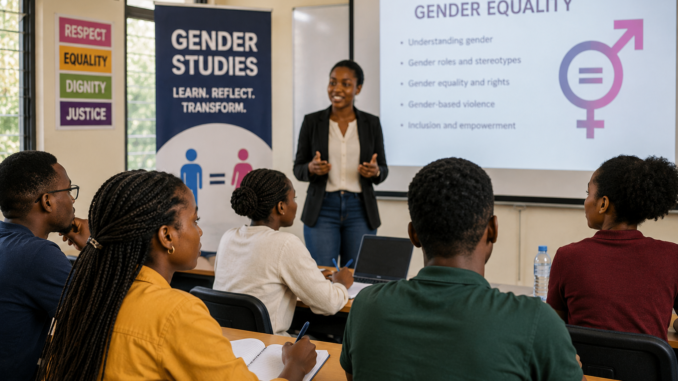
Some students, lecturers, and university leaders say gender-related courses are transforming students’ attitudes and behaviors, creating a visible impact both within academic institutions and in the wider community.
Across Rwanda’s universities, gender studies are no longer viewed as peripheral subjects. Increasingly, they are helping students understand issues of power, responsibility, equality, and inclusion, while encouraging them to apply these principles in their daily lives.
Iradukunda Anitha, a third-year student at University of Rwanda said she had little understanding of gender concepts before joining university.
“Sometimes I would hear discussions about gender in the media or hear that Rwanda ranks highly in promoting gender equality, but I did not fully understand those concepts or how they affect all of us,” she said.
Today, she says her perspective has changed significantly.
“I have become more aware of how language, culture, and traditions can disadvantage certain groups of people,” she said. “Now I challenge biased comments instead of ignoring them.”
Similarly, Umuhire Stecy, a student at the University of Rwanda, said gender courses have reshaped her understanding of society.
“Before taking these courses, I viewed gender issues in a very simple way. Now I understand how inequality between men and women affects education, leadership, employment, and even family life,” she said.
She added that gender education has influenced both her experience on campus and her future aspirations.
“I want to work in an environment where everyone is treated equally,” she said. “These courses have given me confidence and helped me understand my role in promoting fairness.”
Munyengabe James, a university student from the University of Rwanda said his understanding of gender was limited before enrolling in higher education.
“I was confused and unaware. I used to think that gender was about women controlling men,” he said.
According to Munyengabe, that perception changed after studying gender-related courses.
“Most of those stereotypes disappeared. I now understand that gender equality and equity are shared responsibilities that benefit everyone,” he said.
Reverend Uwimana Jean-Pierre, a lecturer and researcher at the University of Rwanda and Deputy Chairperson of the Rwanda Media Commission, said the most important transformation begins with understanding what gender means.
“Gender is not the same as sex,” he explained. “It relates to social roles, responsibilities, and how societies organize power and opportunities. Our role as educators is to help students understand these concepts and apply them in their lives.”
According to Uwimana, the effects of gender education are increasingly visible on campus and in surrounding communities, as students move from awareness to action.
“We are witnessing a shift from awareness to action. Students are increasingly respectful toward one another, and cases related to gender-based misconduct have significantly reduced,” he said.
At the Institut Catholique de Kabgayi (ICK), gender education is also reflected in students’ daily interactions.
Gahamanyi Viateur, Coordinator of Courses and Examinations at ICK, said gender-related content is integrated across different academic programmes.
“The impact is visible in how students organize themselves, collaborate, and live together respectfully,” he said.
He highlighted student clubs, cultural groups, and classroom leadership structures as important spaces where students gain knowledge and skills to prevent gender-based violence and address other gender-related challenges.
Gahamanyi acknowledged that some female students still struggle with self-confidence but noted that continuous awareness programmes are helping to address the issue.
Niyiranga Emmanuel, Deputy Dean of Students at ICK, said gender equality has become part of the institution’s culture.
“No one is marginalized because they are a man or a woman. Participation and leadership opportunities are based on skills, talent, and commitment,” he said.
Dr. Odette Mpungirehe, Head of the Department of Journalism and Communication at the University of Rwanda, emphasized the transformative role of gender education in shaping students’ mindsets and behavior.
“These courses play a crucial role in promoting harmony among students and fostering mutual respect,” she said.
Dr. Mpungirehe noted a significant shift in students’ attitudes in recent years and encouraged learners to apply the knowledge gained in class beyond the university environment.
“As future leaders and role models, students should use these lessons to promote equality and inclusion within their communities,” she said.
According to Rwanda’s National Gender Policy, developed by the Ministry of Gender and Family Promotion (MIGEPROF), gender education is a key driver of equitable development and social cohesion. The policy encourages institutions of higher learning to integrate gender perspectives into curricula and learning environments in order to prepare graduates for inclusive social transformation.
Nzayurugo Fils Albert, Head of the Mass Communication Department at the East African University Rwanda, said gender courses promote equality, human rights, and responsible media practice.
“These courses encourage fair representation of all groups in society. For journalism students in particular, the knowledge gained will help them educate the public and promote inclusive reporting, which is one of the key roles of the media,” he said.
As universities continue to strengthen gender-responsive learning environments, many students and educators believe that gender education is doing more than expanding knowledge. It is helping shape attitudes, challenge stereotypes, and prepare a generation that is more aware of the importance of equality and inclusion.
While challenges remain, the experiences shared across different universities suggest that gender education is increasingly becoming an important tool for fostering respectful, equitable, and inclusive academic communities.
Author: David Nkurunziza