

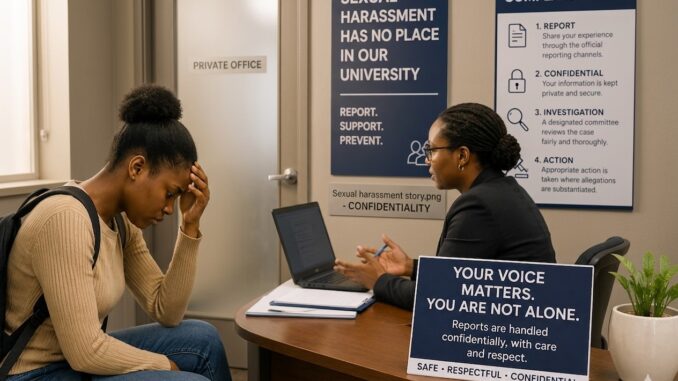
Students across various universities in Rwanda say they are increasingly willing to report cases of sexual harassment, citing growing awareness, stronger institutional policies, and efforts to create safer learning environments.
Interviews conducted at the East African University Rwanda (EAUR), Institut Catholique de Kabgayi (ICK), Mount Kigali University (MKU), and the University of Rwanda (UR) suggest that awareness of sexual harassment and reporting mechanisms is increasing, although concerns about retaliation and stigma remain. Sexual harassment is generally defined as any unwelcome behavior of a sexual nature, including comments, gestures, requests, or actions that may create discomfort, undermine dignity, or disrupt a positive learning environment.
For many students, confidence in university systems plays a key role in their willingness to speak out. Unogeye Julienne, a student at EAUR’s Kigali Campus, said she would feel comfortable reporting any incident of sexual harassment.
“The university should remain a safe space where students can seek solutions without fear or hesitation. Trust in institutional systems is essential if students are to report concerns and have them addressed properly,” she said.
Similar confidence was expressed by students at other institutions. Iribagiza Teta Meghan, a student at ICK, shared a similar view.
“I care about my safety and my right to learn in a respectful environment. If a lecturer is not performing their responsibilities professionally or is engaging in harassment, they should be held accountable. Staying silent only allows the behavior to continue,” she said.
While many students expressed readiness to report misconduct, others pointed out that the decision is often influenced by personal and social factors. Denise Uwamahoro, also a student at ICK, said she would report sexual harassment but understands why some students hesitate.
“Reporting helps protect victims and prevents similar incidents from happening to others. However, some students may fear retaliation, embarrassment, or not being believed,” she said.
Despite these concerns, several students emphasized that reporting remains an important tool for accountability and prevention. Nayebare Hope, a student at Mount Kigali University, said reporting sexual harassment is important not only for personal protection but also for preventing future abuse.
“I would feel comfortable reporting sexual harassment involving either a lecturer or a fellow student because it helps ensure accountability and prevents similar incidents from recurring,” she said.
Likewise, Hakizamungu Ange, a student at the University of Rwanda’s Huye Campus and a member of the Gender Club, said awareness initiatives have strengthened students’ understanding of consent, dignity, and responsible behavior.
“I feel comfortable reporting any case of sexual harassment that may arise,” she said, adding that awareness programmes have helped promote a more respectful and inclusive campus culture.
Universities Strengthen Prevention Measures
While students describe growing awareness and confidence in reporting mechanisms, university officials say these gains are supported by institutional policies and prevention programmes designed to address sexual harassment before it occurs.
Fils Albert Nzayurugo, Head of the Mass Communication Department at the East African University Rwanda, said the institution has a formal sexual harassment policy that outlines prohibited conduct, reporting procedures, investigation mechanisms, and disciplinary measures.
“The university has a formal sexual harassment policy in place as part of its commitment to providing a safe, respectful, and conducive learning and working environment for both students and staff,” he said.
According to Nzayurugo, the policy is designed to ensure fairness, confidentiality, and accountability when handling complaints.
He added that no formal cases of sexual harassment have been confirmed within his department, although the university investigates all reported concerns in accordance with established procedures.
Beyond formal policies, universities are also investing in preventive approaches that encourage respectful interactions among members of the academic community. At Institut Catholique de Kabgayi, Gahamanyi Viateur, Coordinator of Courses and Examinations, said promoting respectful communication is an important preventive measure.
“Sexual harassment can be committed by anyone, whether a student or a lecturer,” he said. “However, particular attention should be paid to power imbalances, especially those that may exist between lecturers and students,” he added.
He explained that encouraging respectful dialogue and responsible conduct helps build a culture where students feel safe, valued, and protected.
Power Imbalances Remain a Concern
Even as universities strengthen prevention measures, some educators argue that addressing power dynamics remains critical to combating sexual harassment in higher education.
Muhangi Garry Duncan, Coordinator of the ICK Language Resource Centre, said lecturers hold positions of authority that can affect students’ academic lives.
“In my opinion, lecturers are more likely to harass students because they possess authority and decision-making power that students do not have,” he said.
According to Muhangi, maintaining strong professional ethics and accountability mechanisms is essential to preventing abuse and protecting students.
He added that universities should continue creating environments where students feel comfortable expressing concerns and seeking support when needed.
Breaking the Silence
Taken together, the perspectives of students and university officials suggest that awareness, dialogue, and clear reporting systems are helping strengthen efforts to prevent sexual harassment across campuses.
While those interviewed generally expressed confidence in existing support structures, some acknowledged that fears of retaliation, embarrassment, or social stigma can still discourage reporting.
These concerns are reflected in broader national trends. Although comprehensive data on sexual harassment in Rwanda’s universities is limited, national research indicates that sexual violence remains a concern in society.
An analysis of the 2020 Rwanda Demographic and Health Survey found that 12.4 percent of women aged 15 to 49 reported experiencing sexual violence. Sexual harassment is mostly defined as any unwelcome behavior of a sexual nature, including comments, gestures, or actions that may create discomfort or disrupt a positive learning environment.
Against this backdrop, students and educators agree that creating safer and more inclusive learning environments requires more than policies and procedures alone. It also demands a culture in which victims feel heard, protected, and supported when they choose to speak out.
Author: Uwase Gihozo Lina