

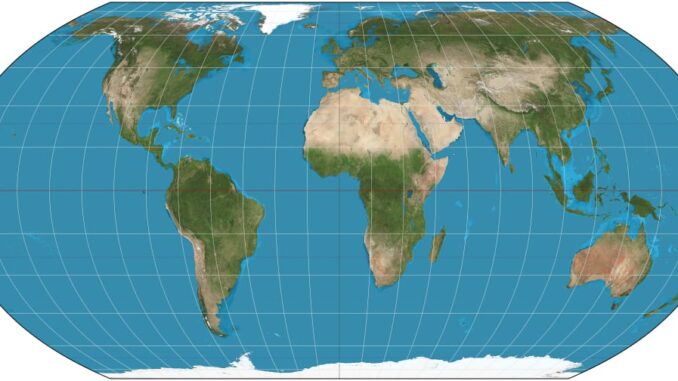
The United Nations voted for endorsing a new standard for how the world map should look like. The vote passed 164 to 1, with six abstentions with The United States being the sole vote against it.
This was yesterday on September 4, 2026 at the UN Headquarters, New York, USA.
In 1569, a Flemish cartographer named Gerardus Mercator created a world map designed to help sailors navigate using straight compass lines. It became the standard map used in schools, atlases, and navigation systems for centuries, and it’s still one of the most widely used projections today, even in classrooms and on digital maps.
But the Mercator map significantly distorted the true relative sizes of countries, because it stretched landmasses further from the equator while shrinking those near it. This meant Europe and North America appeared much larger than they really are, while Africa, Latin America, and South Asia appeared much smaller.
In 2018, three cartographers —Bojan Šavrič, Tom Patterson, and Bernhard Jenny — created an alternative called the Equal Earth projection, designed to show countries and continents at their true relative sizes while still looking visually similar to a globe.
Starting around 2025-2026, Togo, backed by the African Union and the Caribbean Community, led a diplomatic campaign called “Correct the Map,” pushing the United Nations to formally endorse Equal Earth as a replacement standard, arguing that the Mercator distortion had contributed to what they called the “symbolic minimization” of Africa in global perception.
And on Friday, September 4, 2026, the UN General Assembly voted on the resolution. It passed 164 votes in favor, with six countries abstaining — Estonia, Georgia, Lithuania, Moldova, Serbia, and Ukraine.
The United States was the only country to vote against it.
“Resolutions like this one and the ideological agenda they promote, are barnacles on our work here, and the reason this institution is losing credibility” said Yaryna Ferencevych, callin, the representative of the U.S. in the Assembly. She also illustrated that the US urges countries to “instill common sense” and reject the idea.
In her interview with France 24, the deputy Executive Director of Speak Up Africa — an organization that focuses on amplifying African leadership, Fara Ndiaye, emphasized that a Map is not politically neutral. “If Africa is shown as smaller than it truly is, African themselves internalize the sense of marginality” she remarked.
The resolution itself is not legally binding. It doesn’t ban the Mercator projection or force any country to switch. It simply encourages governments, schools, international organizations, and tech companies to adopt Equal Earth or similar equal-area projections when relative size is what matters, and to teach students about the limitations of flattening a sphere onto a flat map.
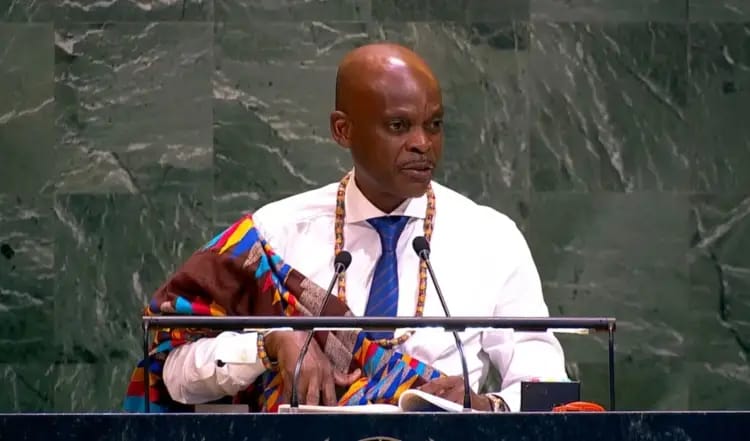
Robert Dussey, Togo’s Foreign Minister
Togo’s Foreign Minister, Robert Dussey, who led the push, said the goal wasn’t to discredit Mercator’s usefulness for navigation, but to change how the world visually represents itself: “A fair map does not change the geography of the world, it changes how we see the world.” He said.