


Thirty-one students studying journalism and related fields on Thursday, January 22, 2026, completed a four-day training in investigative and data journalism aimed at strengthening the practice of in-depth reporting in Rwanda.
The training, held in Muhanga, was organized by Fojo Media Institute in partnership with the Rwanda Media Program. It focused on equipping emerging journalists with practical skills and techniques to help develop and activate the investigative journalism sector in the country.
The sessions were led by award-winning retired Canadian investigative journalist Steve Buist, who emphasized the role of journalism in combating misinformation and serving the public interest.
“People are relying on false information and everyone throws around fake news; we have a job to play to educate people so that people should make reasonable decisions about how their lives should be,” Buist told participants.
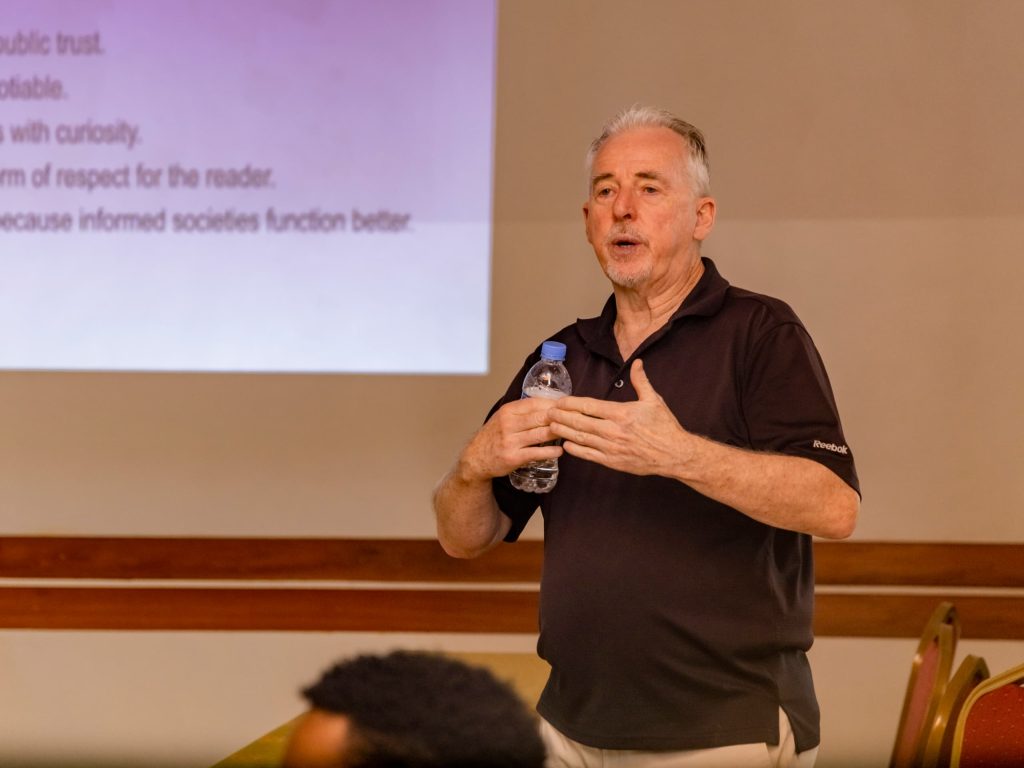
Canadian investigative journalist Steve Buist during training session at Splendid Hotel, Muhanga
Drawing on more than 40 years of experience, Buist said investigative journalism should not be seen as intimidating or separate from everyday reporting.
“It’s a fancy title, but at the end of the day, everything you do with investigative journalism is the same stuff that you do with regular journalism, so the first step is for people to just embrace it,” he said.
He also challenged the perception that investigative journalism focuses only on corruption.
“In Africa, people hear the words ‘investigative journalism’ and all they think about is corruption. What I hope people learn here is that lots and lots of investigative journalism has nothing to do with corruption,” he said, adding that journalists serve as “the eyes and the ears of the public.”
Local media professionals echoed the need for stronger public-interest reporting. Fulgence Niyonagize, a Rwandan print journalist and media coordinator at the Rwanda Media Program, echoed the need for stronger public-interest reportin.
“There are only a few people who try to dig deep into some stories, and that is because most journalists are afraid to do it,” he said. “The most important thing is asking, ‘What kind of change will this story make?’ That does not necessarily need to be investigative for it to be risky.”
Students said the training encouraged them to apply what they learned through practical assignments.

15 students from ICK and 16 from EAUR benefited from the training
“As junior journalists, when we get this opportunity to learn about investigative journalism which is purposeful and impactful in society, we are ready to utilize it, because there is a demand for it in the labor market,” said Richard Ahishakiye, a Mass Communication student at East African University Rwanda.
Diane Ishimwe, a sophomore Public Relations student from Institut Catholique de Kabgayi, said the training changed her approach to storytelling.
“I was used to doing normal stories, but from now on I will start to do stories where I investigate, go deeper, and get to the roots of the issue,” she said.
Buist encouraged the students to put the tools they gained into practice.
“If you just go out and put some of this into practice, whether it’s writing a story for a newspaper, a website, radio, or television, I would be in tears of joy,” he said.
The training is part of an ongoing initiative by Fojo Media Institute/Rwanda Media Program, which has previously worked with four higher learning institutions that offer journalism and related studies.
This latest cohort included 31 students from Institut Catholique de Kabgayi and East African University Rwanda, majoring in Journalism, Mass Communication, and Public Relations.


Author: Jules Roger Rwema