

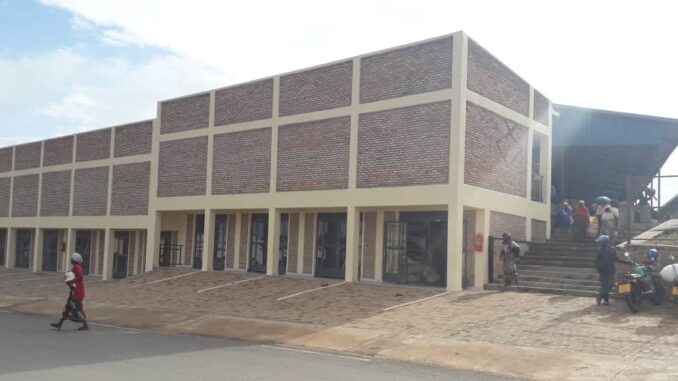
As the newly renovated Nyabisindu Market in Nyamabuye Sector, Muhanga District, was expected to address the challenges of informal and disorganized trading, many traders have expressed concern that the rental fees are beyond their financial means.
The market renovation began at the end of February 2025 and was officially inaugurated in March 2026.
Marie Grace Uwera, a trader who sells fruits and vegetables, says it is difficult for her to afford a monthly rental fee of 15,000 RWF when her business capital is less than 5,000 RWF.
“I operate with capital that does not exceed 5,000 RWF, yet I am required to pay 15,000 RWF in monthly rent. This makes it very difficult for me to continue my business,” she said.
For traders operating in the larger shop section, Claude Mugabo noted that although they are expected to pay 350,000 RWF instead of the 500,000 RWF charged at Muhanga Modern Market, the cost remains too high. According to him, the new market is still unaffordable for many traders who could not secure space in the main market because of high rental fees.
As a result, many traders have continued to operate along roadsides, a practice that local authorities say poses security and public order concerns.
One vendor, who requested anonymity because she is involved in unauthorized street trading, explained that roadside trading is the only option that matches his financial situation.
“The fact that we sell here is not because we are opposing the government. We are simply working according to our financial capacity. I cannot have capital of 5,000 RWF and then pay 15,000 RWF for a trading space. We were told that a market had been built for us, but when we arrived, we found that it was beyond our means,” he said.
Traders are now calling on authorities to review and reduce the rental fees. They argue that it is difficult to pay rent, taxes, and support their families under the current pricing structure. They are appealing to the government to consider their financial realities.
The Vice Mayor of Muhanga District in charge of Economic Development, Eric Bizimana, stated that public infrastructure is not built to be offered free of charge but must generate benefits in accordance with existing laws and regulations.
“The government does not build infrastructure to provide it free of charge. Support to citizens is guided by the law governing markets, which establishes procedures for allocating market spaces and determining rental prices,” he said.
He also encouraged traders to comply with market regulations, compete for the remaining available spaces, and move away from roadside trading, which he said disrupts public order and security.
The Nyabisindu Market was established to relocate small scale traders from informal and disorderly trading environments. While operating in the market was initially free of charge, traders are now required to pay 15,000 RWF for a standard stall and up to 350,000 RWF for larger shop spaces.
Despite the government’s efforts to organize trade through modern market infrastructure, a gap remains between what authorities expect traders to pay and what many traders say they can realistically afford.
Author: Adolphe Nsanzimana