

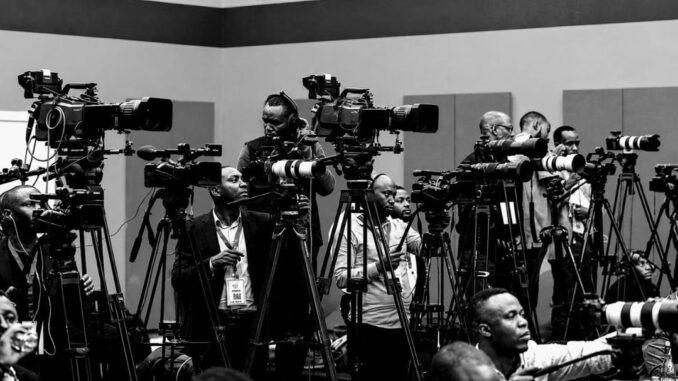
A new study on Rwanda’s media sector has revealed a profession filled with experienced and committed practitioners, but one still struggling with low pay, unstable employment, and structural weaknesses.
The survey, commissioned by the Rwanda Journalists Association under the DDAG program supported by the United Nations Development Programme and the Rwanda Governance Board, gathered information from 1,209 media professionals across the country. The findings were released in Kigali on 21 May 2026.
Out of 490 respondents, 470 were confirmed to be active media practitioners. The report shows that Rwanda’s media industry is largely dominated by experienced professionals, with 44.5% of journalists aged between 35 and 44 years, while 35.3% are between 25 and 34 years old. More than 70% of respondents said they have worked in the media sector for between six and twenty years.
Despite this level of experience, the study found significant gaps in professional training. About 37.4% of journalists do not have formal education in journalism or media studies, while only 5.1%t hold a master’s degree in the field. The report also highlighted concerns over professional accreditation, revealing that only 56.3% possess valid press cards, while 39.6% continue to use expired credentials.
Employment conditions were also identified as a major concern. Only 44.8% of journalists have permanent full time jobs, while 20.6% work as freelancers. Others depend on temporary or part time contracts.
The study further revealed serious financial difficulties among media practitioners. Only 2.77% of respondents said their salaries fully cover basic living expenses, while 43.4% reported that their income meets only a small portion of their needs. Around 17.2 % earn less than RWF 100,000 per month, and 36.2 % rely on additional jobs to supplement their income.
Housing and social protection also remain challenges within the sector. Nearly 68.9 % of journalists rent their homes, while only 24.3% own houses. In addition, 40.2% are not affiliated with any pension scheme, raising concerns about their long term financial security.
The report pointed to a persistent gender imbalance in Rwanda’s media industry. Men account for 76.2% of the workforce, compared to 23.6% for women. It also revealed that 47% of journalists have experienced some form of harassment or intimidation, including verbal threats, legal intimidation, online abuse, and sexual harassment.
Financial sustainability of media houses emerged as another critical issue. According to the findings, 65.1% of media outlets rely mainly on advertising revenue, making them vulnerable to economic shocks and pressure from advertisers.
Despite these challenges, many journalists remain committed to the profession. The study found that 55.7% intend to continue working in the media industry, while 34.5% said they would remain if working conditions improve.
The report recommends stronger enforcement of labour laws, better salaries and insurance coverage, increased support for women in media, and reforms aimed at improving the sustainability and independence