

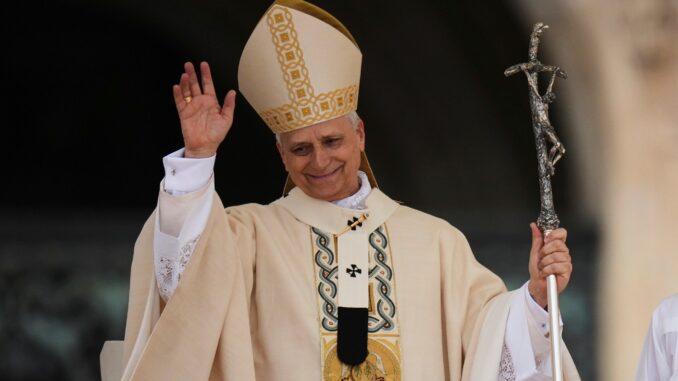
A year after his election to the Chair of Saint Peter, Pope Leo XIV has emerged as a leader focused more on institutional discipline, administrative adjustments, and diplomatic engagement than on spectacle.
Elected on 8 May 2025 after the death of Pope Francis, the first American pope took the reins of a Catholic Church facing internal ideological tensions, unfinished reforms, and growing geopolitical instability. In his first year, Leo XIV has aimed to reassure different factions within the Church while gradually shaping a papacy that blends continuity with some corrections from the Francis era.
According to Vatican News, the new pope indicated early on that he would maintain the broad pastoral direction set by Vatican II and the synodal process started under Francis. At the same time, he made it clear that he wanted to restore clearer governance structures within the Roman Curia (“Cardinal elected Pope takes the name Leo XIV,” Vatican News, May 2025).
A more centralized and disciplined Roman Curia
The most noticeable changes during Leo XIV’s first year have occurred within the Vatican administration. As a former prefect of the Dicastery for Bishops, Leo has a strong understanding of how the Church governs itself.
One of his first decisions was to keep Cardinal Pietro Parolin as Secretary of State. This move was seen as an effort to ensure stability and prevent disruption. However, Vatican observers have noted that the Secretariat of State has also regained a stronger coordinating role, which had become less focused and personalized under Francis.
In a June 2025 speech to the Secretariat of State officials, Leo XIV stressed the importance of “unity of governance” and “coherent collaboration” among Vatican departments (Vatican News, June 2025). Many in Rome interpreted this speech as a critique of the fragmented decision-making that sometimes marked the previous papacy.
The pope also approved new internal rules for Vatican departments in the fall of 2025. Documents released by the Holy See Press Office reveal that these reforms set stricter rules on budgeting, personnel management, and accountability. Several Italian experts described these measures as the most significant bureaucratic change since the reforms implemented under John Paul II.
While Francis often led through personal initiatives and informal networks, Leo XIV seems committed to strengthening institutional channels and restoring predictability in the Curia.
Continuity with Francis, but with clearer boundaries
On theological and church matters, Leo XIV has taken a balancing approach. He has repeatedly shown support for synodality, collegiality among bishops, and the Church’s global outreach. In messages to the Synod Secretariat, he highlighted the importance of “a listening Church” and encouraged the continuation of the synodal process initiated by Francis (Vatican News, May 2025).
Yet, his approach contrasts sharply with that of his predecessor. Francis embraced spontaneity, symbolic gestures, and informal interviews, while Leo XIV has favored well-prepared speeches, focused communication, and quieter behind-the-scenes discussions.
This shift in tone has also been evident in Vatican appointments. Several individuals linked to the progressive wing of the Francis papacy have seen their influence wane, while more institutional clerics and diplomats have moved into key roles.
According to several Vatican analysts cited by Le Monde and La Croix International, the goal is not to reverse doctrine but to stabilize the institution after over a decade of internal divisions.
However, significant unresolved issues remain on the Vatican agenda, including the role of women in church governance, LGBTQ pastoral care, accountability for clerical abuse, and financial transparency. On these topics, Leo XIV has so far taken a cautious approach, avoiding sudden changes while promoting unity and internal cohesion.
Vatican diplomacy returns to the foreground
Perhaps the most evident change during Leo XIV’s first year has been in foreign policy and Vatican diplomacy.
Initially cautious about international crises, the pope has gradually adopted a firmer diplomatic stance on the wars in Ukraine and the Middle East. In several Angelus addresses and meetings, he condemned escalation, nationalism, and violence against civilians while advocating for dialogue and respect for international law.
In May 2026, Reuters reported that Vatican diplomats now describe Leo XIV’s foreign policy as “more structured, less improvisational, and institutionally coordinated” compared to the Francis era (“A year into papacy, Leo finds his voice,” Reuters, May 2026).
The Vatican has also boosted mediation efforts through apostolic nuncios and regional bishops’ conferences instead of relying solely on papal symbolism. This approach reflects Leo XIV’s preference for spreading diplomatic authority across the Holy See’s traditional networks.
However, his remarks criticizing military escalation and nationalist rhetoric have created discomfort among some conservative circles in the United States. The pope thus finds himself in a delicate position: An American leader whose moral stances do not always align with Washington’s geopolitical priorities.
The Challenge ahead
After twelve months, Leo XIV’s papacy is still a work in progress rather than a complete ideological transformation.
Supporters claim he has restored administrative coherence, institutional seriousness, and diplomatic credibility to the Vatican after years of tumult. Critics argue that his cautious approach could slow progress on needed Church reforms.
The next crucial stage of his papacy may depend on whether Leo XIV can turn institutional stability into a broader intellectual and spiritual vision for global Catholicism. Vatican officials have suggested that the pope is preparing a significant social teaching document focusing on artificial intelligence, labor, and human dignity—many expect this could become the defining statement of his pontificate.
After one year, it is already clear that Leo XIV is neither a mere continuation of Francis nor a conservative restoring the past. Instead, his papacy is taking shape as an effort to combine pastoral reform, institutional order, and renewed Vatican diplomatic influence.
Author: Emmanuel Mujyakera