

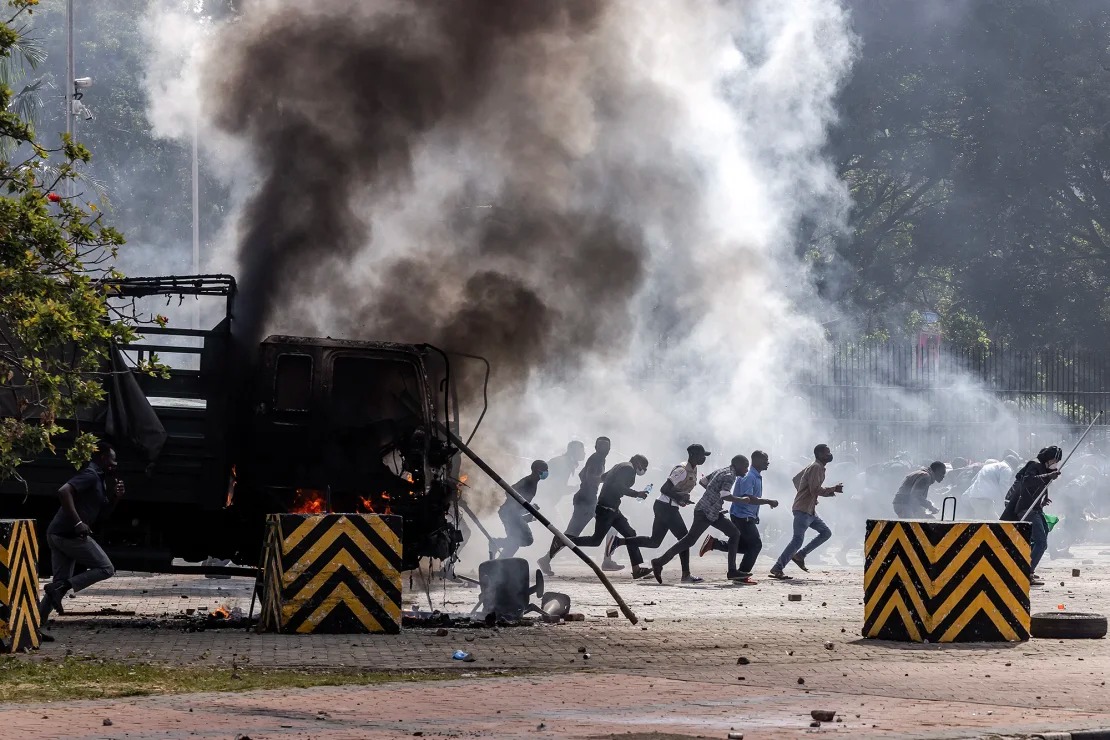
Protesters have reportedly been shot dead, and part of Kenya’s parliament has gone up in flames amid fierce demonstrations against new tax proposals.
An angry crowd broke through police lines to storm the parliamentary complex in the capital, Nairobi. Minutes later, live TV footage showed smoke escaping from inside.
For several hours, police fired tear gas and rubber bullets as thousands of people marched through Nairobi’s streets to denounce tax hikes, which the government says are needed to lower the national debt. Footage from multiple Kenyan media outlets also shows people battling a fire at City Hall, the office of the Nairobi County governor.
The youth-led protests began last week and have now spread to other locations in the country. The Kenya Medical Association reported that police in Nairobi shot dead at least five people during the latest protests on Tuesday.
According to the BBC, about 40 people are reportedly being treated in hospital. Police have not yet commented on casualty figures. At least two people died, and hundreds were injured in last week’s largely peaceful demonstrations.
Why Are Kenyans Protesting?
The finance bill, introduced in Parliament earlier in May, has sparked intense debate and anger. It includes a wide range of tax reforms and increases, such as new levies on monetized digital content creation and a 5% tax increase on digital payments like bank transfers and mobile money. These measures are particularly hard-hitting in a country reliant on mobile money.
However, the proposals that have most angered Kenyans are a 16% value-added tax (VAT) on bread and a 25% excise duty on domestically produced vegetable cooking oil. Additionally, a 2.75% income charge was imposed on salary earners enrolled in the national medical insurance plan, along with a 2.5% annual tax on motor vehicles.
Protesters argue that these taxes will increase overall costs, especially for essential items like bread and cooking oil. They are also furious that the bill grants Kenya’s revenue authorities the power to enforce tax collection by accessing bank and mobile money accounts.
Rollback of Certain Taxes
Last Tuesday, after the protests began, Parliament announced emergency amendments. Kuria Kimani, chairperson of the finance committee, stated in a news conference that lawmakers would roll back taxes on bread, oil, motor vehicles, and financial transactions, including mobile money payments. A proposed “eco levy” on plastic goods like diapers, sanitary towels, and phones would only apply to imported goods, not local manufacturers. Medical and housing insurance levies for salary earners were also reduced.
Despite these amendments, the protests continued, with many demonstrators demanding the entire bill be dropped. On Thursday, protesters attempted to occupy Parliament buildings where legislators were gathering for a second reading of the bill. Social media saw young people rallying with hashtags like #RejectFinanceBill2024 and #OccupyParliament. Lawyers and doctors mobilized to free those detained and treat the injured.
Security officials justified the violence in Nairobi by stating they respected the constitutional right to protest but needed to protect government institutions. They claimed they acted when protesters threatened the security around Parliament House. In other cities, the protests remained peaceful.
Political Sensitivity and Implications
The bill is particularly contentious because it comes amid rising food and living costs in Kenya and follows previous tax hikes in 2023. Protesters argue that since the 2022 swearing-in of President Ruto’s government, taxes have increased while public services have not noticeably improved. They accuse Ruto’s administration of imposing taxes not to improve social amenities but for corrupt reasons.
Last year, a finance law introduced a 1.5% housing tax on the gross income of salaried workers and doubled VAT on petroleum products from 8% to 16%, despite smaller protests warning it would further burden struggling Kenyans. Ruto, who campaigned on promises to ease life for Kenya’s working-class “hustlers,” justifies the recent tax proposals, saying they are necessary to pay off a public debt of 11.1 trillion Kenyan shillings ($82bn), much of which is owed to China. He also aims to meet a 2024 revenue target of 3.3 trillion Kenyan shillings ($26m).
“We are a democratic country. Those who want to demonstrate, it is their right, no problem. But decisions have to be made by institutions,” Ruto said last Wednesday. He later signaled a willingness to speak directly to protesters, although no meetings were organized.
Parliamentary Vote and Future Outlook
Despite the massive demonstrations, lawmakers passed the bill on Tuesday. Most of Parliament is allied with Ruto’s ruling Kenya Kwanza alliance. Of 359 MPs, 195 voted “yes,” while 106 voted “no.” Three votes were invalid. Ruto’s allies claim the law will create revenue for hiring more teachers, funding local governments, and improving infrastructure. However, the One Kenya opposition coalition insists it will only burden Kenyans, calling for the bill to be entirely discarded.
The bill is now headed to Ruto’s desk for signing into law. If signed, observers expect the violence to escalate. If Ruto decides to return it to Parliament for a revote, the political climate may become even more volatile. The conduct of the Kenyan police could attract international scrutiny, particularly as Kenya leads a major international force deployment in troubled Haiti.
Young critics of the finance bill, some of whom have not voted before, are closely watching how their representatives are voting. Many promise to mobilize, register, and vote out Ruto’s cabinet in the 2027 elections, with some already calling for Ruto to step down.
Source: CNN, AFP, Reuters, AP, Aljazeera and BBC
