

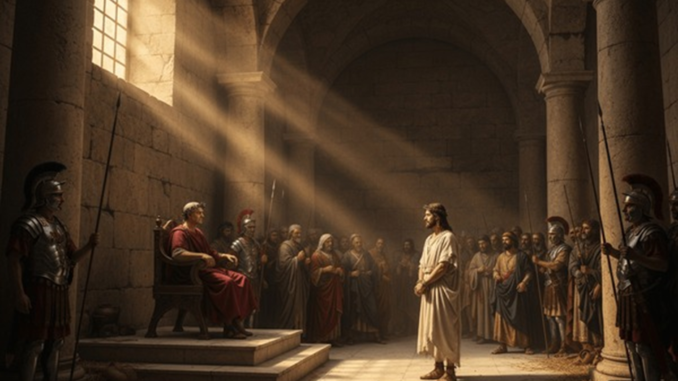
The second phase of the trial of Jesus Christ reveals a complex intersection of religion, politics, and law under Roman rule. Scholars continue to revisit this moment in history to better understand how authority was exercised and how responsibility for the final verdict was determined.
The Trial of Jesus before Pontius Pilate
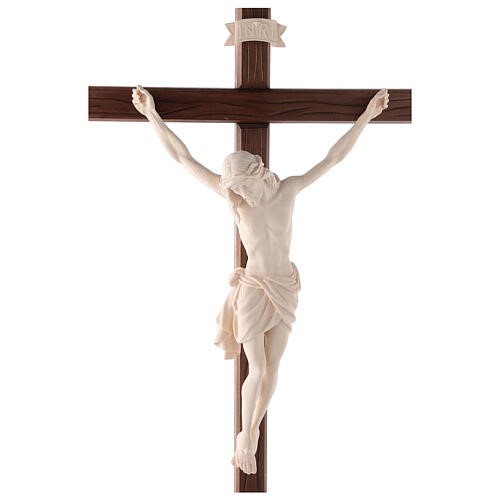
The second part of this trial takes place before the Roman tribunal, where a delegation from the Sanhedrin explains: “We found this man misleading our nation: he opposes payment of taxes to the emperor and claims that he is the Christ, a king” (Luke 23:2). The Romans had a deep fear of any form of sedition or uprising against their authority. Moreover, the titulus, the inscription that Pilate had placed above the cross, bore these revealing words: “Jesus, King of the Jews.” These converging indications suggest that Jesus was condemned by the Roman authorities as a political agitator and insurgent.
If the condemnation comes from Pilate rather than the Sanhedrin, it is because, at that time, the Jewish court no longer had the authority to pronounce the death penalty and had to refer such matters to the Roman authorities. To obtain a capital sentence, the Sanhedrin needed a charge other than a purely religious one, something the Romans would recognize. The accusation of revolutionary agitation, however, constituted a fully acceptable political charge. Jesus was therefore brought before Pilate, the procurator of Judea.
Pilate’s personality appears to be judged differently depending on the sources. In a letter to Caligula, the Jewish philosopher Philo accuses Pilate of “corruption, violence, theft, torture, abuses, executions without trial, and constant and intolerable cruelty.” Indeed, Pilate had already violently suppressed troublemakers, as Luke reports, and he was later removed from office by the Roman governor of Syria.
Archaeology has uncovered a stone in the theater of Caesarea Maritima bearing an inscription that mentions the name of the prefect Pilatus.
Pilate is irritated at being disturbed by the Temple authorities, who moreover refuse to enter the praetorium (a Roman place considered impure) for fear of defiling themselves before Passover. “Are you the King of the Jews?” he asks Jesus. And Jesus replies: “My kingdom is not of this world. If it were, my servants would fight to prevent my arrest” (John 18:36).
Upon learning that Jesus is from Galilee, the procurator tries to rid himself of this troublesome case by referring it to Herod Antipas, tetrarch of Galilee, under whose jurisdiction Jesus supposedly falls. But Herod sends him back after having him mocked and mistreated.
The texts then recount a strange episode in which Pilate attempts to save Jesus by invoking an alleged custom of releasing a prisoner at Passover. However, the crowd demands that Barabbas, a zealot who had taken part in an uprising be released instead of Jesus. Yet there is no historical evidence for such a Passover amnesty. Moreover, if Barabbas had been condemned to death, only the Roman emperor could have granted him a pardon.
Who bears responsibility for the death of Jesus?
The trial of Jesus comes to an end: Pilate pronounces the death sentence by crucifixion, the most terrible of punishments, deemed unworthy of a free man.
One of the central figures in this trial is clearly the Roman procurator Pilate. Yet the New Testament presents him differently from his historical character, particularly in the episode of the so-called “Passover amnesty”. Still, Mark seems to portray his weakness when he yields to the demands of the crowd in deciding the prisoner’s fate. Matthew adds that Pilate washes his hands of the matter, leaving the Jewish people to assume full responsibility.
The polemical intent against the Jews is evident.” However, the term “Jews” in this context actually refers to Jesus’ opponents, namely certain groups such as the Sadducees and Pharisees who secured his condemnation.
According to the Jewish historian Flavius Josephus, only the Roman prefect held the power of life and death. Furthermore, a baraita (Ancient Jewish oral teaching) states that the Sanhedrin lost the authority to judge criminal cases forty years before the destruction of the Temple, which historically occurred in the year 70.
Ultimately, responsibility for Jesus’ death rests jointly with the Roman authorities and the Jewish Sanhedrin: the former for pronouncing the death sentence, and the latter for handing Jesus over to those who held that power. However, under no circumstances should the reader of the New Testament attribute this responsibility to the Jewish people as a whole. Only certain authorities, on both sides, bear the heavy burden of this execution.