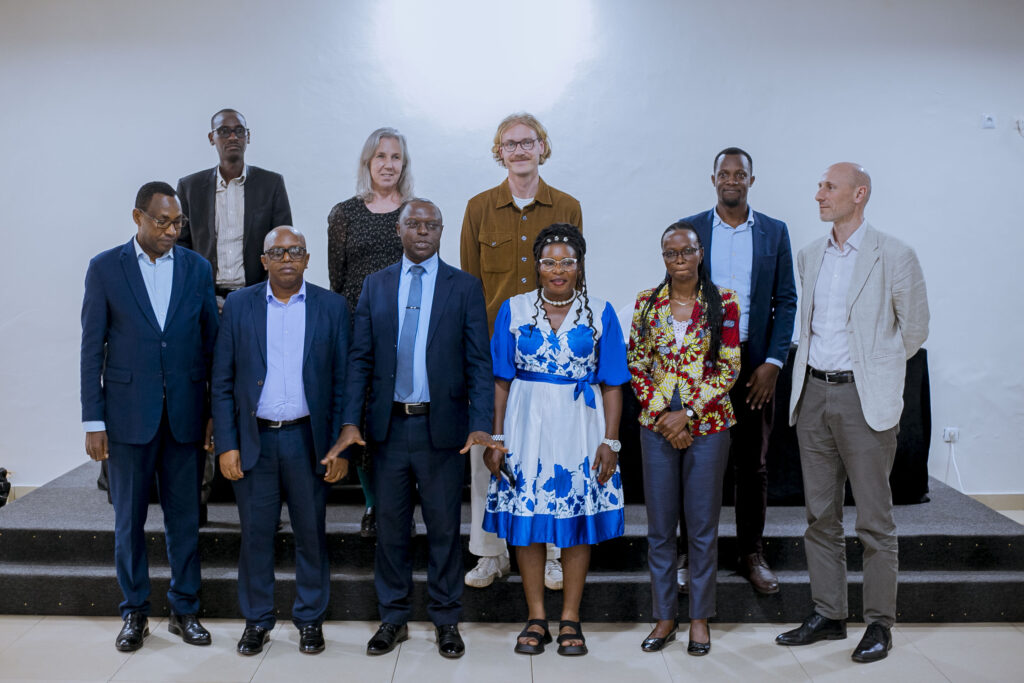
On March 14, 2025, lecturers from the four universities teaching Journalism and Communication in Rwanda gathered at Lucerna Hotel in Muhanga to officially launch the Rwanda Journalism Educators Network (RJEN), supported by the Fojo Media Institute.
The lecturers and educators in this network represent Institut Catholique de Kabgayi (ICK), the University of Rwanda (UR), East African University Rwanda (EAUR), and Mount Kigali University (MKU).
This gathering was attended by Paul Rapacioli, Director of Fojo Media Institute; Anneli Frank, International Programme Manager at Fojo Media Institute; Prof. Kabera Callixte, Vice Chancellor of East African University Rwanda; Father Dr. Prudence Bicamumpaka, Deputy Vice Chancellor for Academics and Research at ICK; Dr. Alphonse Mulefu, Principal of CASS at the University of Rwanda; Mugisha Emmanuel, Executive Secretary of the Rwanda Media Commission (RMC); and other distinguished guests.

During the Assembly, several key activities took place, including the signing of the organization’s founding statute and the election of the executive committee members for RJEN.
In an interview with ICK News, the newly elected president, Rev. Jean Pierre Uwimana, a senior lecturer in the Journalism Department at the University of Rwanda, explained the key reasons behind the day’s preparations.
“The main purpose of this inaugural assembly was to launch the network, connect its members, vote for the committee, draft the governing laws, and sign the statute,” he said.
Rev. Uwimana also shared how the idea to form this network came about. “Last year, we attended the EACA conference in Tanzania and discovered that other journalism educators across Africa had established their own networks. For example, the African Journalism Education Network (AJEN) caught our attention. This experience opened our eyes to the benefits of collaboration, knowledge sharing, and collective growth.”
He further emphasized the impact of working together. “When people with diverse experiences come together, they can build something strong let’s say in research not only in how we teach students but also in advancing journalism as a profession across Africa.”
Regarding his committee’s priorities and what members should expect, Rev. Uwimana stated that they have already started thinking broadly about how to develop the network to fulfill its vision and mission.
“We will work to combat unprofessionalism in journalism by ensuring that only qualified individuals teach journalism in universities and practice the profession. Journalism is not a job for just anyone; it requires proper knowledge and expertise. Lack of professionalism leads to issues such as defamation,” he emphasized.
He added that another key focus will be improving research among lecturers. “Currently, revising the journalism education curriculum in Rwanda takes around three years. While waiting for these official changes, we will explore ways to make immediate improvements. Additionally, we want to ensure that collaboration extends beyond just our network members.”
Rev. Uwimana also mentioned that the committee will soon meet to prepare a short-term action plan, which will serve as the foundation for a long-term strategic plan.
Emmanuel Mugisha, the Executive Secretary of the Rwanda Media Commission (RMC), stated that bringing lecturers together in one network is a significant step, emphasizing that its greatest impact will be on future generations.
As for RMC’s recommendations, Mugisha explained that they urged the network to design courses that address the challenges journalists face and meet the demands of the job market.
“With the rapid advancement of technology, we want universities to incorporate modern teaching methods, including Artificial Intelligence, Virtual Reality, storytelling techniques, and advanced communication systems. These are essential skills for the future of journalism,“he said.
This sentiment was echoed by Prof. Kabera Callixte, Vice Chancellor of East African University Rwanda, who emphasized that this is not a time for competition but rather a time to unite efforts, energy, and time to work together.
“I would like to thank Fojo for their support in helping us build the journalism profession. To the lecturers, I believe that if you combine your energy, skills, networks, and efforts, you will be able to achieve great things,”he said.
The elected committee members are: Rev. Jean Pierre Uwimana (President), Andrew Onsongo (Vice President), Dr. Joyce Kirabo (2nd Vice President), Jeanne d’Arc Mukamana (Secretary), and Jean Baptiste Hategekimana (Treasurer).