

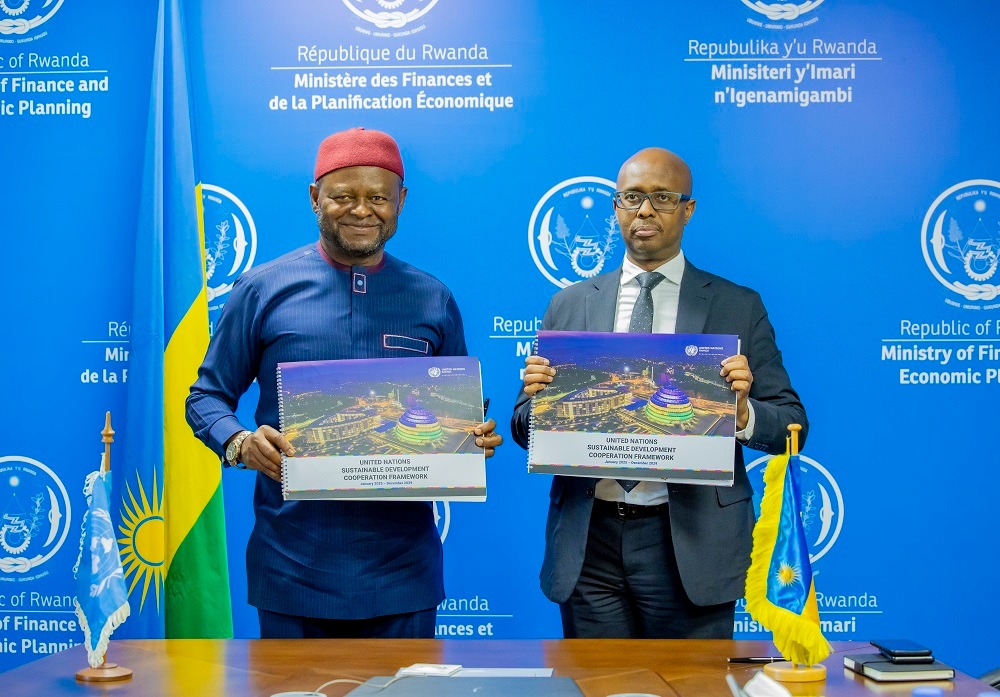
The United Nations has announced it will provide $1.04 billion to support Rwanda’s development over a five-year period from 2025 to 2029, as part of a new partnership with the Government of Rwanda aimed at fostering sustainable growth.
This commitment was formalized on May 20, 2025, when the Government of Rwanda and the UN signed the United Nations Sustainable Development Cooperation Framework (UNSDCF), which outlines joint efforts to promote inclusive and resilient development.
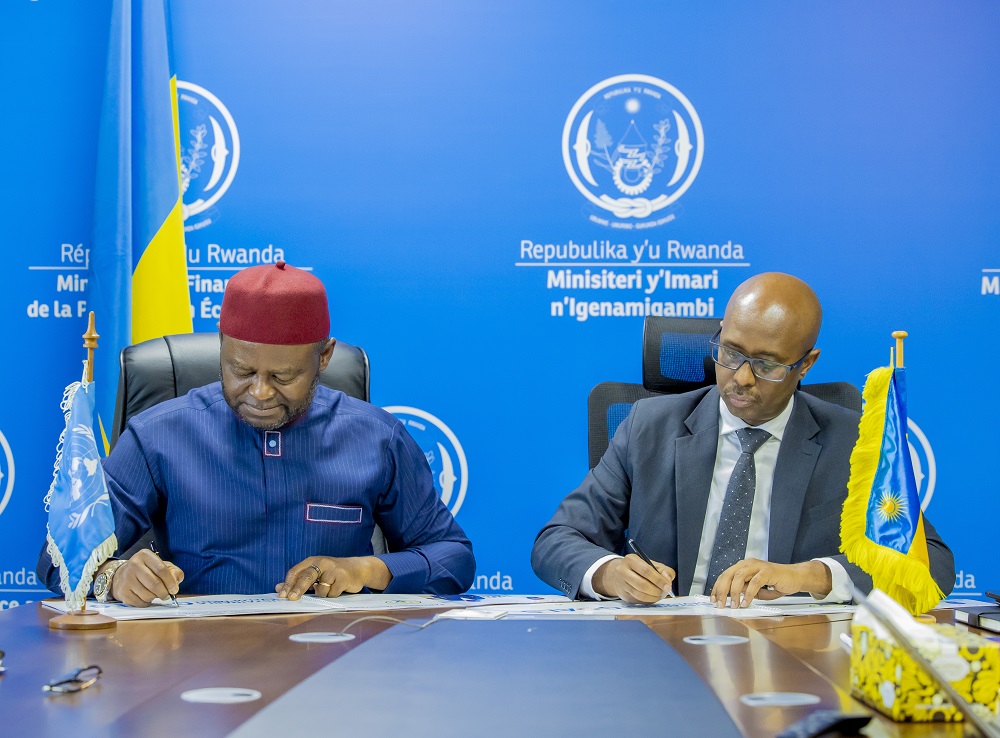
The agreement was signed on Rwanda’s behalf by the Minister of Finance and Economic Planning, Yusuf Murangwa, and by the UN Resident Coordinator in Rwanda, Ozonnia Ojielo.
The five-year program is expected to strengthen collaboration between Rwanda and the UN to achieve the Sustainable Development Goals (SDGs).
Minister Yusuf Murangwa stated, “This new cooperation framework is a testament to the strong partnership between Rwanda and the United Nations, and to Rwanda’s vision for a prosperous, inclusive, and sustainable future. It reflects our shared values and our commitment to leaving no one behind.”
According to a press release from the Ministry of Finance and Economic Planning (MINECOFIN), the $1.04 billion will be allocated to key development areas such as inclusive economic growth, human capital development, transformative governance, gender equality, climate resilience, and innovation.
The funding will support jointly agreed programs, including innovation-driven initiatives, civil society activities, and private sector engagement.
UN Resident Coordinator Ozonnia Ojielo noted, “As the United Nations marks its 80th anniversary, this cooperation framework underscores our shared commitment to work together and support Rwanda’s transformational journey.”
The development of the framework involved consultations with over 50 government institutions, UN agencies, and various development partners.
It is expected to contribute significantly to addressing global and regional challenges such as climate change, security issues in the region, and financial constraints.
This new UNSDCF phase follows a similar framework that was implemented from 2018 to 2024.
The outlined initiatives align with Rwanda’s second National Strategy for Transformation (NST2) and the country’s Vision 2050. NST2 builds on previous achievements and is designed to accelerate progress toward Rwanda’s long-term goals of sustainable development, economic growth, and improved living standards for all citizens.
The framework aims to bring about long-term change in the lives of Rwandans by prioritizing sustainable development, building climate resilience, and strengthening local industries to reduce the trade deficit.
Other key goals include creating productive jobs, enhancing education quality, improving child nutrition and early childhood development to reduce stunting, and delivering better public services while promoting citizen participation.
To ensure effective implementation, the framework emphasizes good governance, efficient institutions, data and technology use, innovation, and capacity building.
Under Vision 2050, Rwanda aspires to achieve upper-middle-income status by 2035 and high-income status by 2050, through inclusive and sustainable economic growth that guarantees well-being for all its citizens.
