


On February 13, the world marks World Radio Day, a date designated in 2011 by the United Nations Educational, Scientific and Cultural Organization (UNESCO) to celebrate radio as a vital medium in human history.
Radio earned its own international day because of the central role it has played in informing, educating and connecting societies. Its origins date back to the late 19th century, following groundbreaking research on electromagnetic waves by scientists such as James Clerk Maxwell and Heinrich Hertz.
In 1895, Guglielmo Marconi successfully transmitted the first radio signal, paving the way for wireless communication. A decade later, in 1906, Reginald Fessenden made the first radio audio broadcast, demonstrating that radio could carry voice and music, not just coded signals.
By 1920, the first commercial radio station, KDKA in the United States, began regular broadcasting. Radio quickly became a primary source of news and entertainment. During the 1930s and 1940s, it played a crucial role in wartime communication, especially throughout World War II.
The invention of portable transistor radios in the 1950s and 1960s brought the medium even closer to the public, expanding its reach worldwide. In the early 21st century, radio adapted once again, moving onto digital platforms through internet streaming services such as TuneIn and the rise of podcasts.
The birth of radio in Rwanda
In Rwanda, radio history dates back to 1960. At the time, there was only one Kinyarwanda-language station: Radio Rwanda. For many Rwandans, it remains a vivid memory — a trusted companion in an era when no other mass media existed to break the silence.
When Radio Rwanda officially launched in 1961, the country lacked basic infrastructure. Electricity was scarce in rural areas, and alternatives such as solar power were nonexistent. Owning and operating a radio required careful budgeting. Families purchased radio batteries — brands such as Nationale and Tiger — and when they weakened, they were dried in the sun in hopes of squeezing out a few more hours of listening time.
Broadcasting hours were limited. The station aired from 5 a.m. to 8 a.m., then resumed from 11 a.m. until 11 p.m. Unlike today’s 24-hour programming, airtime was structured and scarce. Still, Radio Rwanda became a lifeline, offering news, drama, and music requests.
The rise and dark chapter of private Radios
Until 1992, Radio Rwanda remained the country’s sole broadcaster. That year saw the emergence of Radio Muhabura, followed in 1993 by Radio Télévision Libre des Mille Collines (RTLM).
Media historians note that Radio Muhabura, reportedly linked to the FPR Inkotanyi, had limited listenership, as tuning in was stigmatized at the time. RTLM, launched in July 1993, initially attracted young audiences with popular music from what was then Zaïre, now the Democratic Republic of Congo.
However, RTLM later became notorious for spreading hate propaganda. It played a significant role in inciting violence during the 1994 Genocide against the Tutsi, even broadcasting names of individuals targeted for killing. Its legacy remains one of the darkest chapters in Rwanda’s media history.
After the genocide, Radio Rwanda was once again the only operating station. It was not until 2004 that private radio stations began to re-emerge, led by Radio 10. As of September 2024, according to the Rwanda Utilities Regulatory Authority (Rwanda Utilities Regulatory Authority), 34 radio stations were licensed nationwide. The most recent addition is SK FM, founded by journalist Sam Karenzi.
From Reel Tapes to TuneIn
Veteran journalists recall a time when reporting required heavy equipment and painstaking editing. Eugene Hagabimana, a lecturer at the University of Rwanda’s School of Journalism, describes the use of the “Nagra” recorder, a device weighing nearly 10 kilograms , to capture audio in the field.
Editing involved a manual technique known as “cut and splice,” where reporters physically cut and reassembled magnetic tape to shape their stories. It was labor-intensive and required precision.
Today, technology has transformed the newsroom. With the advent of the internet, journalists can record, edit and transmit stories instantly using smartphones or laptops. Radio itself has become globally accessible through online streaming.
A Changing Media Landscape
Journalist Gerard Manzi of Pax Press says radio once dominated Rwanda’s information ecosystem, particularly because print newspapers such as Kinyamateka reached limited audiences in a country where literacy rates were low.
But the rise of digital media and social platforms has diversified how Rwandans consume information. While radio remains influential, especially in rural areas with limited access to smartphones and television, it no longer monopolizes public attention.
Manzi warns that competition for audiences has led some outlets to prioritize sensational or misleading content to attract listeners. He stresses that radio’s core responsibility remains delivering accurate, verified information.
Despite financial challenges in the profession, Manzi maintains that journalism is a lifelong calling. “A good journalist works professionally and with passion,” he says.
Radio’s Enduring Mission
Radio’s mission has remained constant: to inform, educate and entertain. From heavy reel-to-reel recorders to live internet streaming, it has evolved with the times, yet its voice continues to resonate.
On this World Radio Day, Rwanda joins the global community in celebrating a medium that has not only reported history but shaped it, a trusted companion that once filled lonely homes with sound, and still connects millions today.
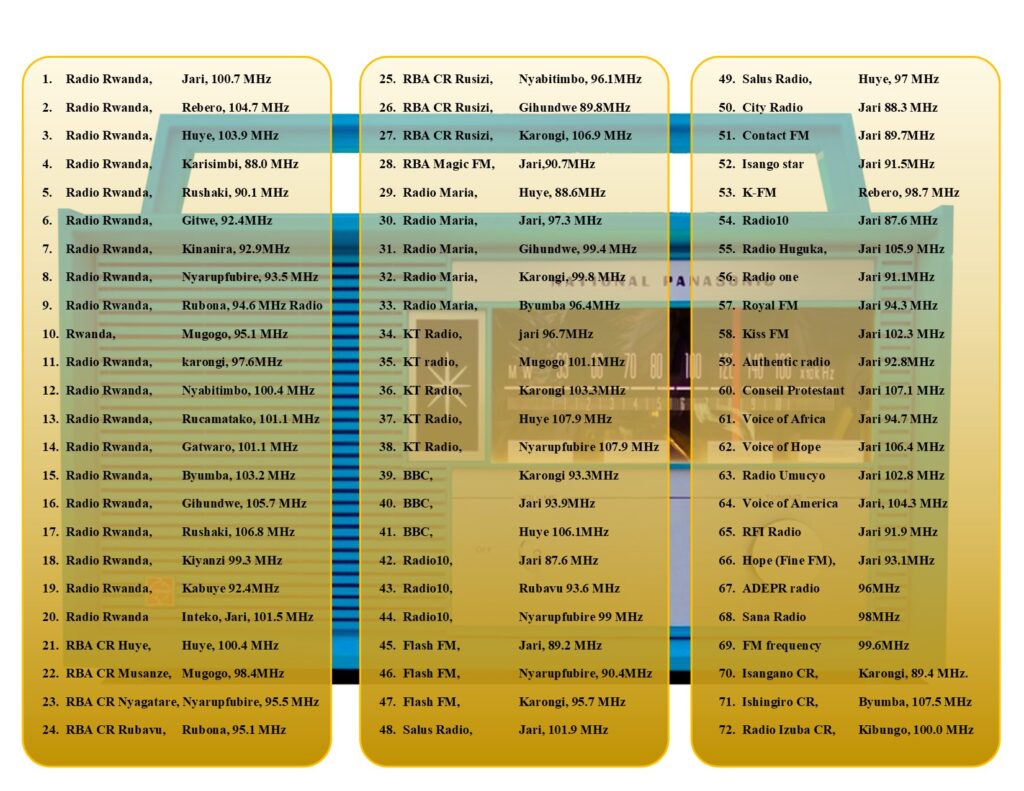
Rwanda now has more than 35 licensed radio stations operating across the country